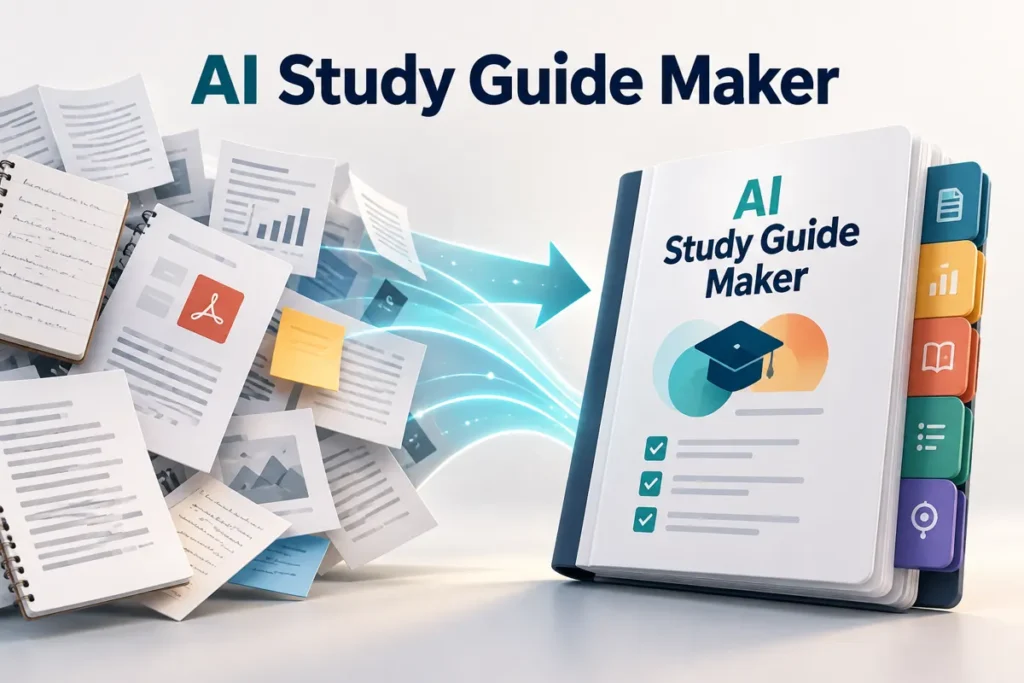
A study guide should help you decide what to practice. If it merely rewrites the textbook into shorter paragraphs, it may be tidier than your notes without being much more useful. An AI study guide maker works best when you give it a learning objective, a small source collection and a format that includes questions.
Practical example & checks
A finished one-topic study guide from a small source
Source: Speed equals distance divided by time. For constant speed, distance equals speed multiplied by time. Keep distance and time units consistent.
Revision sheet: constant speed
- Definition: speed is distance travelled per unit time.
- Formulas: v = d/t; d = vt; t = d/v, with nonzero denominators.
- Worked example: 150 km in 3 h gives 150 ÷ 3 = 50 km/h.
- Common error: dividing kilometres by minutes but labelling the result km/h.
Practice and self-check
- Find distance at 60 km/h for 2.5 h. Answer: 150 km.
- Find time for 90 km at 45 km/h. Answer: 2 h.
- Explain why 30 minutes must become 0.5 hours when using km/h.
Coverage check: This sheet covers constant-speed relationships only. Acceleration, vectors and changing speed are outside this supplied source. A generated guide that adds those topics should label them as additions and provide separate evidence. Close the sheet and solve a fresh problem before considering the topic learned.
Original ThinkQuarry teaching material added 19 October 2026. Hypothetical examples are not product-test results.
Here is a practical way to build a guide you can actually revise from. The examples are illustrative; they are not results from a product test.
Start with the syllabus, not the upload button
Write down the topics your course expects you to understand. Then match each topic to its lecture, reading or worksheet. This gives the AI a boundary and gives you a coverage checklist.
For a small economics module, your list might include demand, supply, equilibrium and elasticity. A generated guide that explains demand beautifully but skips elasticity is incomplete. That matters more than how fluent the writing sounds.
Use the instructor's terminology where possible. If your notes call a concept “price elasticity of demand,” do not let the guide quietly replace it with a broader expression that loses the assessed definition.
Choose the right kind of maker
A source workspace is useful when you want to return from a generated explanation to the material behind it. A conversational assistant is useful when you want to negotiate the format or ask follow-up questions. A plain document works well as the final place to edit and store the guide.
You can follow our existing NotebookLM tutorial for source setup. RemNote's AI Tutor documentation also describes producing study guides from documents. Check the features and any credit costs shown in your own account before choosing a workflow.
Make a one-topic prototype
Do not begin by generating a guide for the entire semester. Select one learning objective and enough material to cover it. Ask for a short structure first:
Build a draft study guide from these sources for an introductory course. Use the learning objective below. Include key terms, a plain-language explanation, one worked example, common confusions and five practice questions. Separate the answer key. Refer to source sections where available. If a point is missing from the sources, flag it.
Read the outline, then check the definitions and example. If those are wrong, fix the prompt or source set before expanding. Repeatedly clicking regenerate without identifying the problem usually produces different wording rather than a more dependable guide.
Give each section a clear purpose
Use four blocks: what to know, how it works, what to practice and what still needs checking. Keep the guide compact enough to use beside your source material.
A useful entry for equilibrium could include the course definition, a small supply-and-demand example, a question about a demand shift and a reminder to inspect the relevant graph. It should not claim that this topic will definitely appear in the exam.
Make room for your own correction notes. “I drew the shift in the wrong direction” records a learning problem. A copied paragraph does not.
Check coverage and accuracy separately
First, compare the headings with the syllabus. Second, check the content inside each heading. Confirm equations, units, dates and exceptions. A citation should lead to a passage that supports the particular claim, not simply to a document that mentions the topic.
If a source contains a diagram, examine it yourself. Text extraction may omit labels or misread arrows. Keep the image or page reference beside the relevant explanation so you can verify it quickly.
When two sources disagree, record the disagreement instead of asking the AI to blend them into a confident answer. Ask your instructor which convention or interpretation the course uses.
Turn the guide into a revision session
Hide the answer key. Attempt the practice questions, then mark where you needed help. Create a few flashcards for definitions you keep forgetting and use longer questions for explanations or calculations.
Keep one final version of the guide. Update it when you discover an error rather than leaving several conflicting copies in different apps. A study guide is a working document, not a certificate that a topic has been learned.
Frequently asked questions
Can I make a guide without paying?
Often you can draft a small guide with an available free account or text prompt. Upload limits and credits vary; check the current account limits rather than assuming unlimited use.
How long should the guide be?
Long enough to cover the objective and short enough to practice from. Start with one topic rather than an arbitrary page target.
Should I upload the whole textbook?
Use the relevant material you are permitted to upload. A focused chapter is easier to check than an entire book.
What if the guide adds facts I did not supply?
Ask it to separate source-supported material from additions. Remove unsupported additions until you can verify them.
Is a guide enough for exam preparation?
It is a starting point. Add questions, worked problems and a record of mistakes so revision includes application.