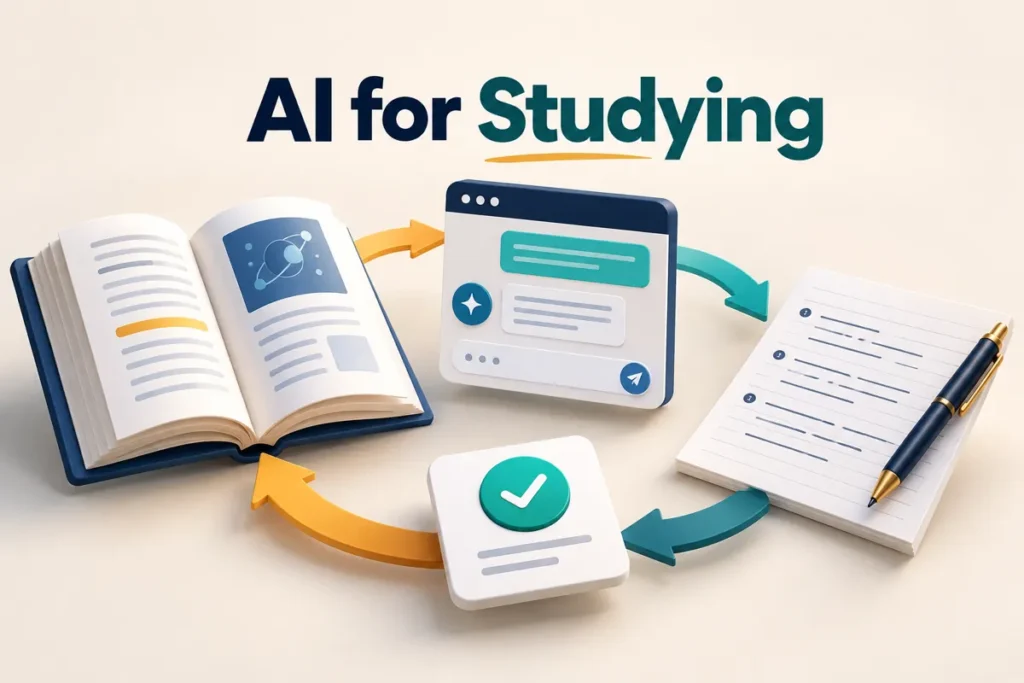
It is easy to finish an AI-assisted session with neat notes and no clear idea whether you learned anything. A better approach is to begin with a question you should be able to answer at the end. Use AI for studying to support that question, then attempt the answer yourself.
Practical example & checks
One complete 25-minute learning session
Goal: distinguish area from perimeter for a rectangle. Source facts: area = length × width; perimeter = 2(length + width).
- Minutes 0–5: attempt a 6 cm by 4 cm rectangle without assistance.
- Minutes 5–10: compare your working: area 24 cm²; perimeter 20 cm. Ask for an explanation only at the first uncertain step.
- Minutes 10–20: solve new rectangles, including 8 cm by 3 cm.
- Minutes 20–25: explain why area and perimeter use different units; record one mistake.
Finish check: the 8-by-3 rectangle has area 24 cm² and perimeter 22 cm. It has the same area as the first rectangle but a different perimeter. If you can explain that difference without reading the generated notes, you have evidence of understanding this small objective. It does not establish mastery of all geometry.
Original ThinkQuarry teaching material added 19 October 2026. Hypothetical examples are not product-test results.
This workflow is designed for a small topic you can practice in one sitting. The suggested timing is an example, not a tested formula or a rule for every subject.
Set an observable goal
“Understand chemistry” is too broad. “Explain the difference between an ionic and a covalent bond using one example of each” gives you a finish line.
Write the goal before opening a chat. Collect the assigned source and identify what you already know. If you can partly answer the question, record that first attempt. It gives you something concrete to improve.
Keep the source material tied to the course. General explanations can help, but they may use terminology or assumptions your class has not introduced.
Ask for help at the point of confusion
Instead of “explain everything,” tell the assistant where you are stuck. You might understand the definition of a variable but not why a particular equation has two solutions.
Try this prompt:
I am studying this topic at an introductory level. Here is my source and my first attempt. Ask one question to identify my misunderstanding. Give a hint before a full solution. After I answer, explain the specific error and give a similar problem.
Use an available guided-learning mode if it suits the task. OpenAI's study-mode help describes question-led explanations and checks of understanding. You can also request that style in an ordinary conversation.
Make the first attempt without assistance
Read the question, close the explanation and write what you think. For a calculation, show your intermediate steps. For an essay topic, sketch the argument and evidence before asking for feedback.
When the answer is wrong, ask where the reasoning first went off track. A full replacement answer may conceal that point. You want to know whether the problem was a definition, an assumption or a calculation.
Then try a second problem with slightly different details. Do not immediately repeat the same numbers and count recognition as understanding.
Use a simple session structure
For a half-hour session, try five minutes choosing the objective, ten minutes working through the confusion, ten minutes practicing independently and five minutes checking and recording mistakes.
Change the timing when the task needs it. A difficult proof may require a longer explanation; vocabulary practice may work in shorter blocks. The structure matters more than the clock: attempt, get feedback, attempt again and review.
Keep an error log with three fields: question, mistake and next action. “Review chapter 3” is vague. “Practice distinguishing fixed costs from variable costs in three examples” tells you what to do tomorrow.
Check feedback against the source
AI can agree with a mistaken premise or invent a reason that sounds convincing. Ask for the source passage behind factual feedback and verify it yourself. In mathematics, check the substitution or calculation independently.
If the assistant and your course source disagree, keep both explanations visible and ask your instructor about the difference. Our AI research guide covers evaluating evidence, but the relevant course convention still matters.
Avoid asking the AI to grade an assignment as if it were your examiner. It can compare your draft with a supplied rubric, but it cannot guarantee the actual mark.
Finish with a useful next step
End the session by answering the original question without the guide. If you still need help, narrow the next objective. If you can explain the idea, plan a later check with a new example.
Save only the material you will use: a corrected explanation, a few practice questions and your error log. Keep generated text separate from submitted work and follow the course's AI-use rules.
Frequently asked questions
Is copying a generated explanation a good study method?
It can provide a reference, but attempt an explanation yourself so you can see what you understand and what you are copying.
Can I ask AI to explain like I am a beginner?
Yes. Give your level and source context, then ask it to add detail gradually rather than oversimplify important distinctions.
Should I use AI for every question?
Use it where feedback or clarification helps. Include independent attempts so assistance does not hide gaps.
What should I save after a session?
Keep the corrected explanation, unresolved questions and a specific next practice task.
Can AI guarantee better grades?
No. Its value depends on accuracy, your study habits, the assessment and how you use the assistance.