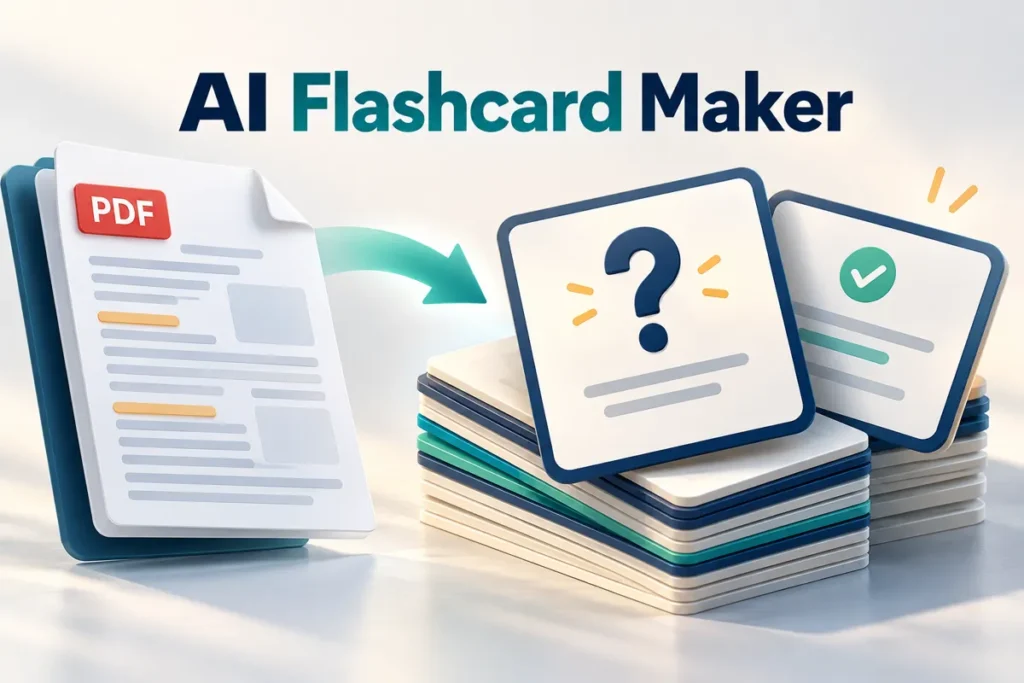
An AI flashcard maker can turn a chapter into a deck in minutes. The harder job is deciding which cards deserve a place in your revision routine. A deck full of vague questions and long answers creates work without giving you a clear way to check recall.
Practical example & checks
An eight-card mini-deck you can review and copy
Source: A fraction a/b represents a divided by b, where b is nonzero. Equivalent fractions represent the same value. Add fractions using a common denominator. Division by zero is undefined.
| Front | Checked back |
|---|---|
| What does 3/4 mean? | 3 divided by 4. |
| Can a denominator equal zero? | No; division by zero is undefined. |
| Give one fraction equivalent to 1/2. | 2/4 (multiply numerator and denominator by 2). |
| What is 1/4 + 1/4? | 2/4 = 1/2. |
| What is 1/2 + 1/4? | 2/4 + 1/4 = 3/4. |
| Why is 1/2 + 1/4 not 2/6? | Denominators describe unit size; first express both in the same units. |
| What is 3/4 as a decimal? | 0.75. |
| What must you preserve when making equivalent fractions? | Multiply or divide numerator and denominator by the same nonzero value. |
Copy one question and answer per card. The calculation examples use the source rules; no card claims to cover an entire chapter. Test recall with the back hidden, then solve a new problem such as 1/3 + 1/6. A correct transfer answer is 1/2. If exporting a deck, check a two-card sample first to confirm the front/back separator.
Original ThinkQuarry teaching material added 19 October 2026. Hypothetical examples are not product-test results.
Start with a small passage, generate a small batch and edit before saving. That keeps quality control manageable.
Write cards that test one idea
“Explain photosynthesis” asks for too much at once. A more focused card could ask which organelle carries out photosynthesis in plant cells. Another card could test the role of light. Keep each answer short enough that you can decide whether you recalled it correctly.
Definitions are not the only useful cards. You can test a distinction, a condition or a common error. For example, “Does correlation alone establish causation?” asks for a specific judgment. The back should include a brief explanation rather than a bare yes or no.
Avoid cards that make sense only when you remember the surrounding paragraph. Replace “What causes this?” with a question that names the process.
Prepare your notes before generation
Remove duplicate passages and label headings. Keep equations, units and diagrams intact. If a PDF is scanned, check that the text was read correctly before creating questions from it.
Choose one learning objective. A twenty-page upload may produce many cards on minor details while missing the distinction your instructor emphasized. Supply the objective and ask the generator to prioritize it.
RemNote's generation documentation describes options for detail and card types, plus previewing generated cards before saving. Use that review stage rather than accepting everything at once.
Use a prompt with clear boundaries
Create eight draft flashcards from this passage. Test one idea per card. Include definitions, important distinctions and one common misconception. Keep answers concise, preserve units and cite the source paragraph when available. Do not add facts absent from the passage. Flag ambiguous questions.
Eight is a practical starting batch, not a special learning threshold. Change the number when your material needs it. If the generator produces compound questions, split them manually.
Review the deck in three passes
First, check facts against the source. Second, check whether the question has one clear answer. Third, check whether the card is useful for the learning objective.
Delete duplicates even when the wording differs. “What is demand?” and “Define demand” are usually the same card. Keep a separate application question if it tests a different skill.
Watch for qualifiers. A card that changes “may” into “always” can teach the wrong rule. If an answer depends on a condition, put that condition in the question or answer.
For diagrams, use an authorized image and a suitable format rather than describing the entire visual on the back of a text card. Check labels yourself.
Make the deck manageable
Introduce cards in batches you can review. A large generated deck is not automatically a better deck. Edit confusing cards when they repeatedly cause problems, and distinguish a badly written question from a concept you do not know.
Keep a way to export your material if you may change tools. Before committing to an app, check current export formats and whether images or formatting carry across.
Use flashcards for focused recall, then add longer practice questions for explanations and calculations. Knowing a formula's name does not establish that you can apply it in a new problem.
Frequently asked questions
Can I make AI flashcards from PDFs?
Some tools support that workflow. Check text extraction and source accuracy before accepting generated cards.
How many cards should I generate?
Start with a batch small enough to review carefully. Add cards for meaningful gaps rather than aiming for a large count.
Should answers be one word?
Sometimes. Use a brief explanation when a one-word answer would conceal an important condition or distinction.
Can I export to another flashcard app?
Check the current export options and test a small deck first, especially when cards contain images or unusual formatting.
Are flashcards enough for every subject?
No. Combine focused recall with problems, explanations, essays or other practice your course requires.