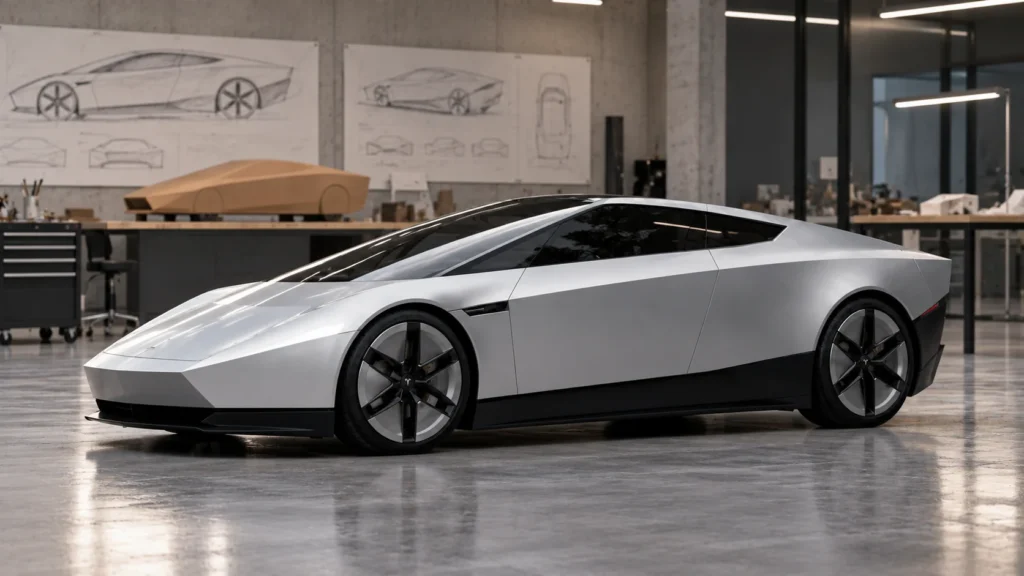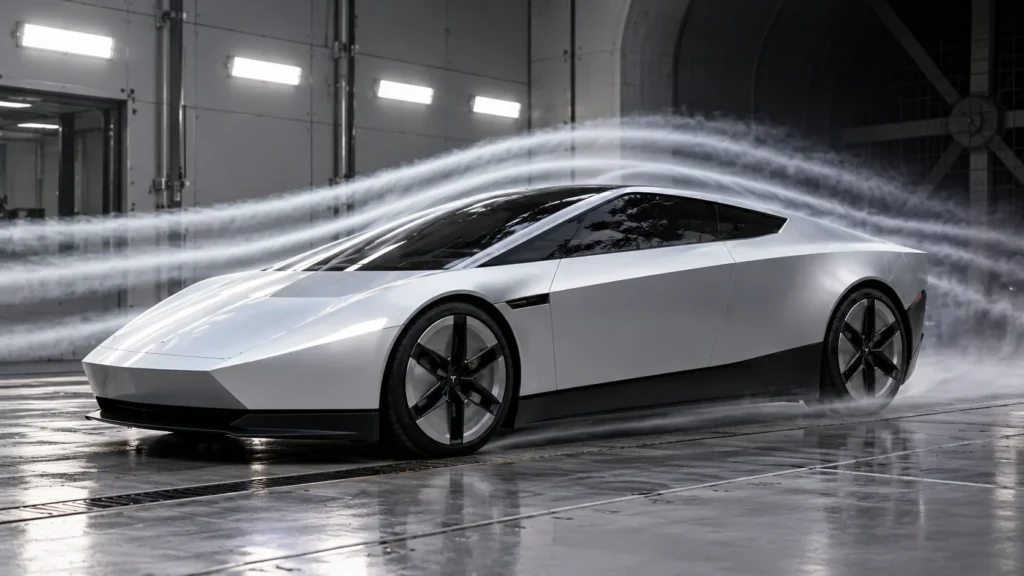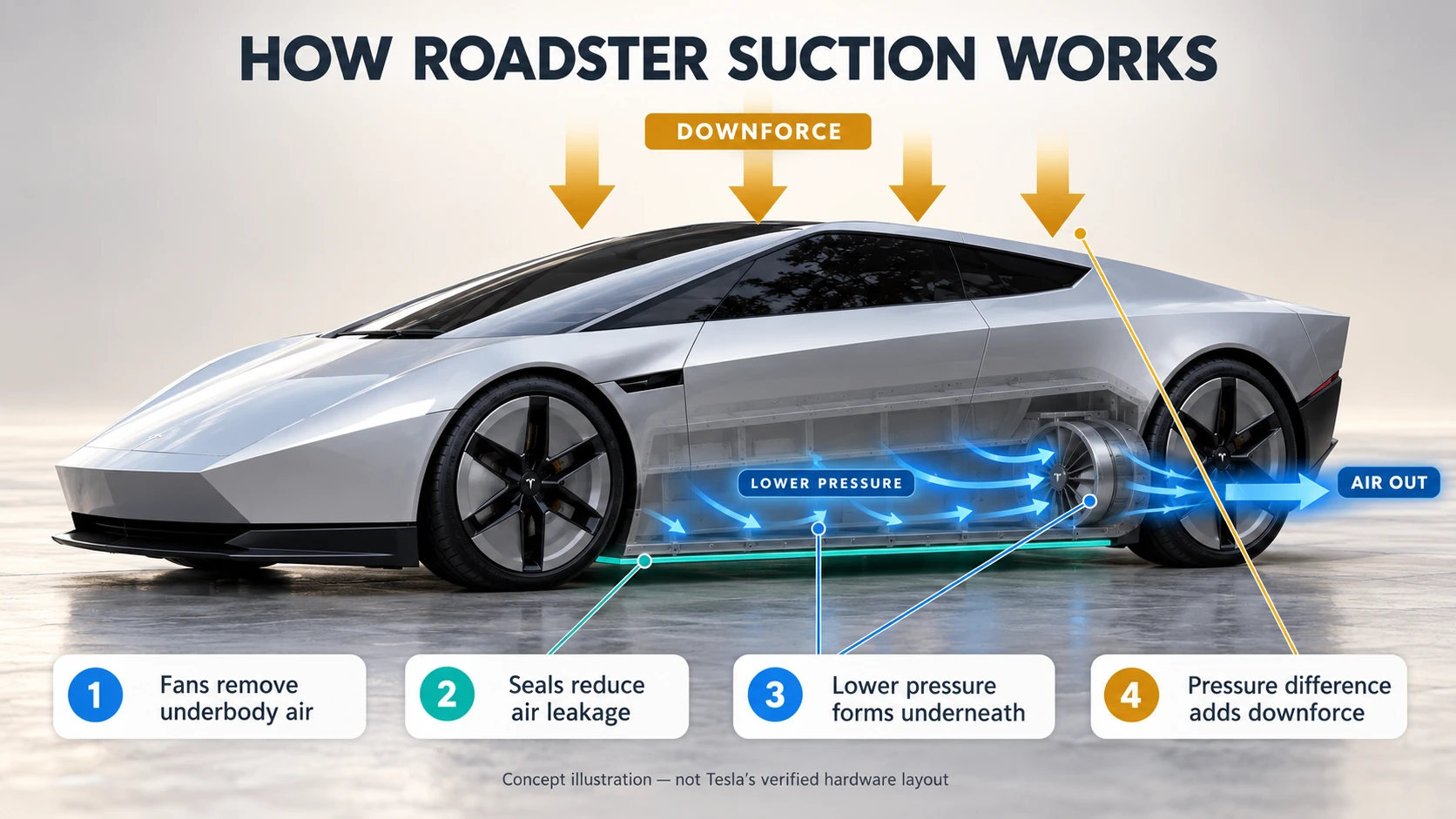
The Tesla Roadster suction system is a fan-based approach to increasing downward force on the car. Tesla describes a multi-mode fan and ground sealing system that removes air from beneath the vehicle. The basic idea is to lower underbody pressure so that the pressure difference helps press the car toward the surface.
That makes suction different from both conventional wings and cold-gas thrusters. This guide explains the mechanism, the role of sealing and the evidence still needed to assess its performance. Research was checked on October 17, 2026. For the wider vehicle overview, see our Tesla Roadster technology and specifications guide.
How does the Tesla Roadster suction system work?
In a general fan-assisted suction system, powered fans move air out of a region beneath the car. Restricting the amount of replacement air entering that region helps maintain lower pressure than the surrounding atmosphere. Pressure acting over the relevant area then produces an additional downward force.
A useful approximation is force = pressure difference × effective area. For example, a hypothetical 1,000-pascal pressure difference across two square metres would correspond to 2,000 newtons of force. These are teaching inputs, not Roadster measurements. A real vehicle has uneven pressure, leakage and a changing relationship with the road.
The fans therefore do more than circulate air for cooling. Their intended aerodynamic role is to help control pressure beneath the vehicle. Tesla’s product presentation identifies this function, but it does not provide a complete engineering drawing from which every component can be independently reconstructed.
Why does ground sealing matter?
Imagine trying to maintain lower pressure inside a container that has an open gap around its edges. Air entering through that gap works against the pressure difference. Under a vehicle, reducing unwanted air leakage can similarly make pressure control more effective.
This does not mean a road car forms a perfect airtight seal. Clearance, surface unevenness and the design of the underbody all influence airflow. Tesla refers to ground sealing, but the reviewed product page does not establish the exact seal materials, clearances, wear characteristics or maintenance intervals.
Those details matter because road conditions vary. A smooth test platform, a bumpy circuit and a wet public road are different environments. Performance across them needs evidence; it cannot be inferred from the existence of a fan alone.
Can fan downforce work when the car is stationary?
In principle, a powered suction system can create a pressure difference without relying on the car’s forward motion. Conventional aerodynamic surfaces, by comparison, depend on airflow relative to the vehicle. NASA’s drag equation illustrates how strongly aerodynamic force can depend on airspeed when other factors are held constant.
Tesla says its system can generate enough suction to hold the vehicle upside down while stationary. That is a manufacturer capability claim, not a certification result established by this article. The page’s configuration and regional footnotes also need to be read alongside such claims. It should not be interpreted as permission for owners to attempt inverted driving.
For a broader explanation of drag, wings and vertical forces, read our Roadster aerodynamics guide. This article concentrates specifically on powered suction and sealing.
How is suction different from rocket thrusters?
| System | Basic mechanism | Main assessment question |
|---|---|---|
| Fan-assisted suction | Controls pressure beneath the vehicle by moving air | What downward force can be maintained under stated conditions? |
| Conventional wing | Produces aerodynamic force from relative airflow | How do force, balance and drag vary with speed and position? |
| Cold-gas thruster | Expels gas to produce a reaction force | What thrust, direction and duration are available? |
Calling all three “rocket technology” hides important differences. A fan system does not become a cold-gas thruster simply because both involve moving gas. Our Roadster cold-gas thrusters explainer covers the separate propulsion mechanism.
What changes with operating modes?
Tesla describes multi-mode operation and says Track Mode changes ride height and suspension behavior, with high-downforce and low-drag settings available as needed. These descriptions suggest a coordinated vehicle system rather than one fixed aerodynamic setting.
However, an operating-mode name does not reveal its complete control strategy. Fan response, leakage control and aerodynamic balance need configuration-specific documentation and measurements. The Roadster specifications guide separates current manufacturer descriptions from missing production figures.
Does the system affect energy consumption?
A powered fan requires energy. Evaluating the benefit therefore involves both the aerodynamic result and the electrical demand needed to obtain it. The relevant question is not simply whether the fan operates, but how much useful force it sustains for a given operating cost.
No verified Roadster fan-power curve or range penalty is asserted here. A meaningful test would state the mode, speed, surface, fan demand and measurement duration. For the distinction between energy storage and power delivery, see our Roadster battery technology guide.
What remains unconfirmed?
The reviewed Tesla page does not establish enough detail to state exact fan motor power, pressure distribution, seal durability, noise level, maintenance cost or wet-road performance. Nor should another manufacturer’s downforce figures be substituted for Tesla’s.
McMurtry documents fan-assisted downforce on its own Spéirling vehicle, showing that powered downforce is a broader engineering category. Its published hardware and performance describe that car, not the Roadster. A responsible comparison keeps each vehicle’s evidence separate.
Frequently asked questions
What is Tesla Roadster suction technology?
It is Tesla’s description of powered fans and ground sealing working to reduce underbody pressure and create additional downward force.
Is the Roadster fan system the same as its thrusters?
No. Suction concerns underbody pressure; cold-gas thrusters produce reaction force by expelling gas.
Does fan downforce need high road speed?
The general mechanism can operate without forward motion. Actual force depends on the system, surface and operating conditions.
Is the system fitted identically to every Roadster?
Do not assume identical equipment or capability. Check Tesla’s current configuration descriptions and footnotes.
How much battery power does Roadster suction use?
A verified model-specific power-consumption figure is not established by the primary product material reviewed here.